
 Colombia
 México
 Italia
 Francia
 Alemania
💪 Full Body Routine at Home: Practical Guide for Beginners Without Equipment

The Challenge of Starting: Why Is It So Hard to Move?
In today's fast-paced life, it's common to feel like time slips through our fingers. Between work responsibilities, household chores, and accumulated fatigue, the idea of going to a gym can seem like an impossible mountain to climb. Many people associate exercise with exhausting two-hour sessions, complex machines, and intimidating environments. However, the reality is much kinder: your body is the only tool you truly need to transform your health.
Sedentary behavior is not just the lack of movement; it is a state that affects our mental energy, mood, and sleep quality. The real problem is not the lack of willpower, but the absence of a method that fits your real life, not that of a professional athlete. A full body routine at home is the perfect solution to break the cycle of inactivity without adding extra stress to your schedule.
Benefits of a Complete and Functional Workout
When we talk about a complete workout, we refer to mobilizing the major muscle groups in a single session. This is not only time-efficient but also improves coordination and calorie burning in a balanced way. By performing a basic routine at home, you are simultaneously working on your strength, endurance, and flexibility.
Choosing equipment-free exercises has advantages that go beyond economic savings. It allows you to better understand your limits, improve your posture, and reduce the risk of injuries, as the movements tend to be more natural and functional. It’s not about seeking a radical aesthetic transformation in a week, but about building a solid foundation of well-being that will accompany you for the rest of your life.
The Importance of Sustainability Over Intensity
One of the most common mistakes when starting is trying to do everything on the first day. The key to success in well-being is not extreme intensity, but consistency. It is preferable to train for 20 minutes three times a week consistently than to do two hours one day and not move again for a month. This routine is designed to be sustainable, realistic, and, above all, safe for those taking their first steps.
Practical Routine to Start Today
This routine is designed to be completed in approximately 25 minutes. You don't need weights or resistance bands, just a small space where you can move freely and a bottle of water to stay hydrated.
Phase 1: Warm-Up (5 minutes)
The goal is to raise your body temperature and prepare your joints.
- Joint Rotations: Make gentle circles with your neck, shoulders, wrists, hips, and ankles (1 minute).
- Marching in Place: Walk in place while slightly raising your knees (2 minutes).
- Arm Circles: Extend your arms and make wide circles forward and backward (2 minutes).
Phase 2: Main Activity (15 minutes)
Perform 3 sets of this circuit. Rest for 45 seconds between each exercise and 90 seconds between each complete set.
- Controlled Squats (12 repetitions): Keep your back straight and lower your hips as if you were going to sit in an invisible chair. Ensure your knees do not excessively pass the tips of your toes.
- Knee-Supported Push-Ups (10 repetitions): Place your hands on the ground shoulder-width apart. Support your knees to facilitate the movement and lower your chest with control.
- Alternating Lunges (10 repetitions per leg): Step forward and lower your back knee toward the ground, maintaining balance.
- Plank (20 to 30 seconds): Support your forearms and toes, keeping your body in a straight line. Engage your core to protect your lower back.
- Glute Bridge (15 repetitions): Lying on your back with your knees bent, raise your hips toward the ceiling, squeezing your glutes as you rise.
Phase 3: Cool Down and Stretching (5 minutes)
Lower your heart rate and relax the worked muscles.
- Cobra Stretch: Lying face down, stretch your arms to gently lift your chest.
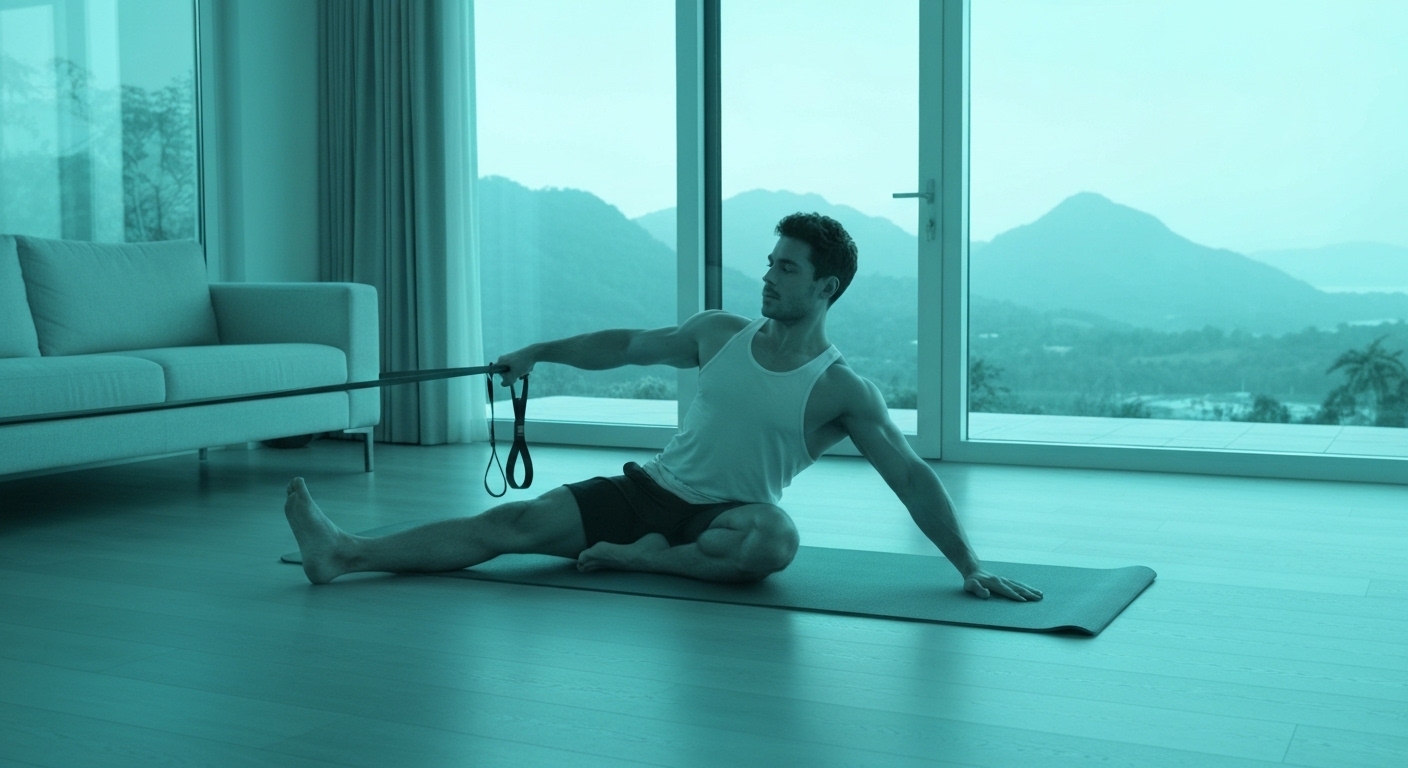
- Hamstring Stretch: Sitting with your legs extended, try to reach your feet without forcing.
- Deep Breathing: Standing, inhale deeply while raising your arms and exhale releasing all the air (repeat 5 times).
Tips to Avoid Giving Up
To make this full body routine at home a habit, try to associate it with a specific time of day. It could be right after you wake up or when you get home from work. Don’t pressure yourself if one day you can’t complete all the repetitions; the important thing is that you took the time to move.
Remember to listen to your body. If you feel sharp pain, stop. Exercise should be a challenge, but never a torture. As the weeks go by, you will notice that you have more energy, that you sleep better, and that those movements that initially seemed difficult now flow naturally.
Frequently Asked Questions About Home Workouts
For beginners, it is ideal to start with 2 or 3 times a week, always leaving a rest day between sessions to allow for muscle recovery.
Although you can do it barefoot if the floor is not slippery, it is recommended to wear comfortable sports shoes that provide support and cushioning to protect your joints.
The mental benefits, such as stress reduction, are felt from the first session. Physical changes are usually noticeable after 4 to 6 weeks of consistency and a balanced diet.
Explore more health tips in our articles on mindful eating, improving sleep quality, and stress management techniques.
Activa tu bienestar hoy
Empieza con una rutina sencilla y construye el hábito paso a paso.