
 Colombia
 México
 Italia
 Francia
 Alemania
💪 Exercises to Strengthen Your Core at Home: A Realistic Guide to Improve Your Posture and Well-Being
The Core: More Than Just a Defined Abdomen
When we hear the word "core", we often immediately think of a defined abdomen or exhausting gym routines. However, the reality of physical well-being is much deeper and more functional. The core, or our central strength, is the engine behind almost all the movements we perform in our daily lives: from bending down to pick something up off the floor to maintaining an upright posture in front of the computer for hours.
The current problem is that sedentary lifestyles and long hours of sitting have weakened this crucial area. This weakness translates not only into a lack of muscle tone but also into recurring back pain, premature fatigue, and poor posture that affects our confidence and energy. Strengthening the core is not about aesthetics; it’s about building a solid foundation for an active and pain-free life.
Why Is It Vital to Do Core Exercises at Home?
Lack of time is the most common excuse for neglecting our physical health. We believe that if we don’t go to the gym for a full hour, the effort isn’t worth it. However, core exercises at home are the perfect solution to integrate movement into a busy schedule. They require no expensive equipment or large spaces, just the willingness to dedicate a few minutes to connect with our bodies.
A proper central strength acts as a natural corset that protects our spine. By working these muscles, we improve balance, optimize breathing, and facilitate the execution of any other physical activity, whether it’s walking, running, or simply playing with our children. The AmigoXtra Well-Being approach is always sustainability: it’s better to do ten consistent minutes than two hours once a month.
Understanding Your Core: It’s Not Just About Abs
It’s a common mistake to limit the core to the rectus abdominis. Central strength also involves the obliques, lower back muscles, pelvic floor, and hip flexors. Working comprehensively ensures that the body functions as a harmonious unit. When performing a routine at home, we aim to activate all these layers to achieve real and lasting benefits.
Recommendations for a Safe and Effective Practice
Before jumping into any routine, it’s essential to remember that the quality of movement always surpasses quantity. Here are some pillars for your home sessions:
- Listen to Your Body: If you feel a sharp pain in your lower back, stop. The effort should be felt in the muscles, not in the joints.
- Breathing is Key: Don’t hold your breath. Exhale at the moment of greatest effort to help activate the deep abdominal muscles.
- Consistency Over Intensity: Don’t aim to exhaust yourself on the first day. The goal is to create a habit that you can maintain long-term.
- Quiet Space: Find a corner of your home where you can stretch comfortably, preferably on a carpet or yoga mat.
Practical Routine to Start Today
This routine is designed to be completed in about 20 to 25 minutes. It’s ideal for beginners and requires no additional materials, just your own body weight.
1. Warm-Up (5 minutes)
- Cat-Cow: In a four-point position, arch your back upwards while inhaling and then downwards while exhaling. Repeat 10 times gently.
- Hip Rotations: Standing, make wide circles with your hips to release tension in the lower back.
- Gentle Activation: Walk in place, slightly lifting your knees for 2 minutes.
2. Main Activity (15 minutes)
Perform 3 sets of the following exercises, resting 30 seconds between each:
- Dead Bug: Lying on your back with arms and legs raised at 90 degrees. Slowly lower your right arm and left leg without letting your back lift off the ground. Alternate sides. (10 repetitions per side).
- Bird-Dog: In a four-point position, extend your right arm and left leg simultaneously, keeping your back straight and abdomen contracted. Hold for 3 seconds and switch. (8 repetitions per side).
- Glute Bridge: Lying on your back with knees bent, lift your hips towards the ceiling by squeezing your glutes and abdomen. Lower slowly. (12 repetitions).
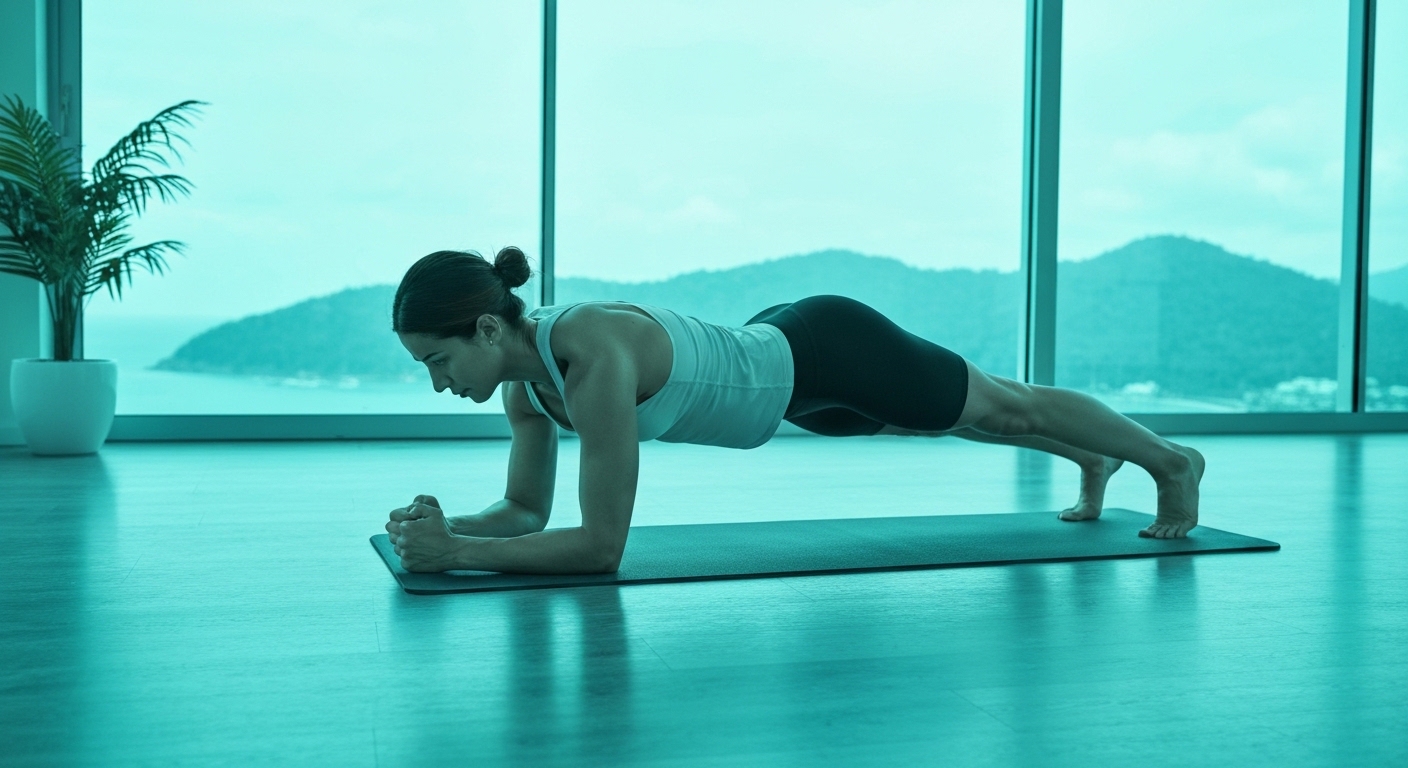
- Front Plank (modified if necessary): Support your forearms and toes (or knees for lower intensity). Keep your body aligned like a plank. (Hold for 20-30 seconds).
3. Closing and Stretching (5 minutes)
- Child’s Pose: Kneeling, bring your glutes to your heels and stretch your arms forward on the ground. Breathe deeply.
- Gentle Abdominal Stretch: Lying face down, support your hands and gently lift your chest (without forcing the lower back).
- Mindful Breathing: Sit in a comfortable position and take 5 deep breaths, focusing on the calm achieved.
Overcoming Mental Obstacles
Often, the biggest challenge is not the physical exercise but the mind telling us we are too tired or don’t have time. To combat this, try to see exercise not as a mandatory task but as a gift for your future health. You don’t need perfection; if one day you can only do 5 minutes of plank, that’s already a victory against a sedentary lifestyle. Central strength is built brick by brick, day by day.
To continue improving your lifestyle, we invite you to explore more about healthy habits, discover new ways to exercise at home, and learn techniques to care for your mental health.
Frequently Asked Questions (FAQ)
1. How many times a week should I do core exercises at home?
For beginners, it is recommended to start with 2 or 3 times a week, leaving intermediate rest days to allow for muscle recovery.
2. Is it normal to feel back pain when doing these exercises?
You may feel muscle fatigue, but not sharp pain. If your back hurts, check your technique or perform modified versions (like supporting your knees in the plank).
3. Do I need to be fit to start this routine?
No, this routine is designed precisely for those who want to start from scratch. The exercises are low-impact and adapt to any initial fitness level.
Activa tu bienestar hoy
Empieza con una rutina sencilla y construye el hábito paso a paso.