
 Colombia
 México
 Italia
 Francia
 Alemania
🧘 Exercises to Relieve Back Pain at Home: A Practical and Realistic Guide
The Challenge of Living with a Tired Back
We spend a large part of the day in front of screens, sitting in chairs that are not always ergonomic or carrying emotional tensions that end up reflecting in our bodies. Back pain is not just a physical discomfort; it is a signal that our body needs movement. Many people believe that to solve this problem, they need expensive equipment or exhausting gym routines, but the reality is that exercises to relieve back pain at home are powerful, accessible, and highly effective tools if performed consistently.
The goal of this guide is not to promise a miraculous cure overnight, but to offer you a sustainable path to regain mobility and improve your quality of life. It is not about training for a marathon, but about restoring the flexibility and support that your spine has lost due to a sedentary lifestyle.
Why Does Our Back Hurt? Beyond Posture
We often blame "poor posture" for all our ills. However, wellness experts agree that the best posture is the following, that is, constant movement. The human body is designed to move, not to remain static for eight hours. When we stay still, the muscles in the lumbar area tense up, the hip flexors shorten, and our spine loses its natural cushioning ability.
Lumbar pain is one of the most common complaints globally. Often, this pain does not stem from a serious injury, but from a lack of mobility in the adjacent joints, such as the hips and the thoracic spine (the middle part of the back). By performing specific exercises at home, we help redistribute the load and allow the muscles to regain their natural tone without additional stress.
The Importance of Mobility and Body Awareness
Before taking action, it is essential to understand that exercise for the back should not cause sharp pain. The key is in the gentleness. Posture improves not because you force yourself to stand straight as a board, but because you strengthen the muscles that naturally support your structure. By integrating small mobility habits, you teach your nervous system that it is safe to move, which reduces the feeling of stiffness and heaviness.
Key Exercises to Perform at Home
For a routine to be effective, it must be simple. Here are some basic movements you can perform in any corner of your home, using only a mat or a clear floor:
- The Cat-Camel: This exercise is ideal for mobilizing each vertebra. In a four-point position, arch your back upwards while tucking your head in, and then let it drop gently while looking forward. It helps lubricate the intervertebral discs.
- Piriformis Stretch: Lying on your back, cross one leg over the other forming a "4" and gently pull the supporting leg towards your chest. This releases tension in the glutes that often radiates pain to the lumbar area.
- Child's Pose: A classic yoga pose that allows the lumbar area to lengthen passively. It is a necessary rest for the paravertebral muscles.
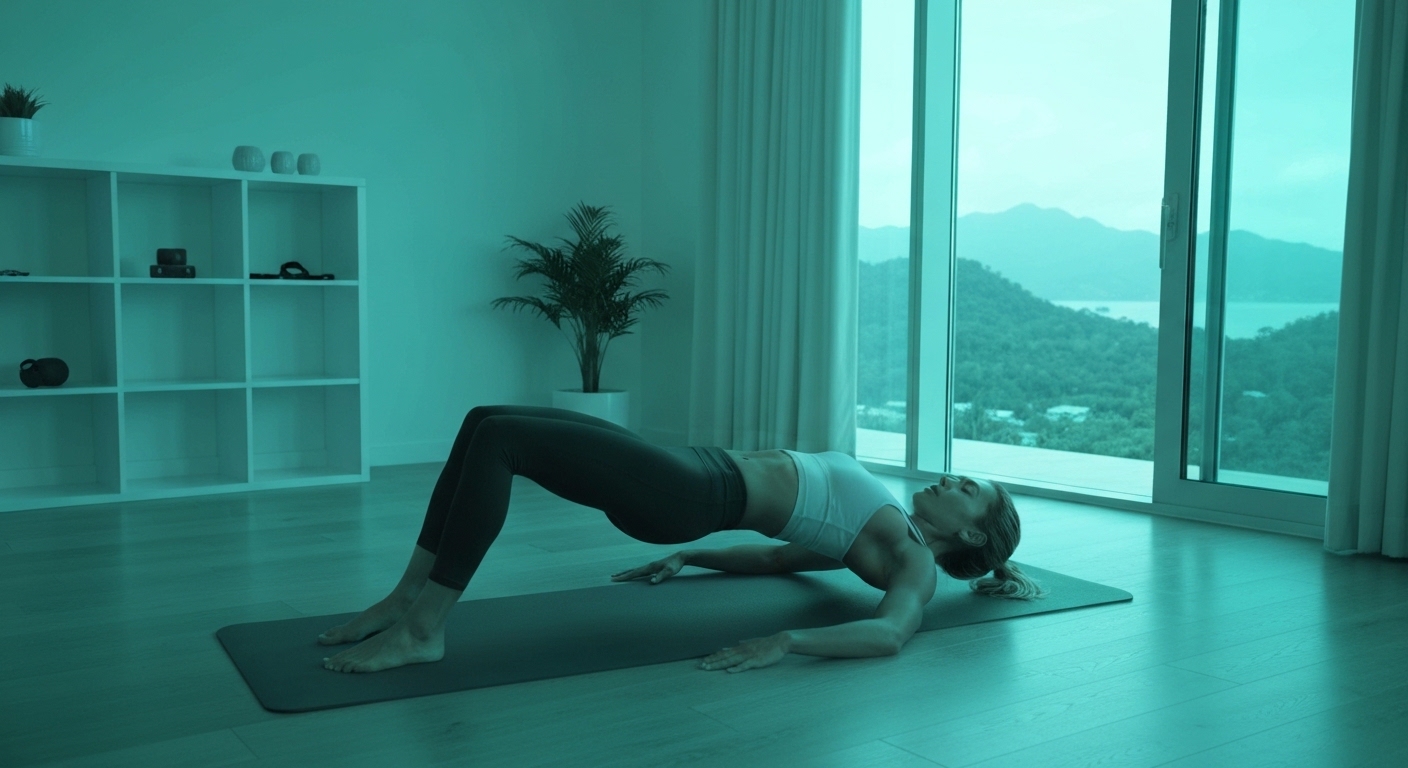
- Glute Bridge: Strengthening the glutes is essential for protecting the back. By raising the pelvis in a controlled manner, you activate the posterior chain and relieve pressure on the lumbar region.
Practical Routine to Start Today
This routine is designed to last approximately 20 minutes. You do not need prior experience, just comfortable clothing and the willingness to listen to your body. Perform it with slow and controlled movements.
Phase 1: Warm-up and Connection (5 minutes)
- Diaphragmatic Breathing: Lie on your back with your knees bent. Place your hands on your abdomen and feel it rise as you inhale and fall as you exhale. This relaxes the nervous system.
- Gentle Neck Rotations: Move your head side to side very slowly to release cervical tension that often travels down to the upper back.
Phase 2: Main Mobility Activity (12 minutes)
- Cat-Camel: Perform 10 slow repetitions, coordinating with your breathing.
- Bird-Dog: In a four-point position, extend your right arm and left leg simultaneously. Hold for 3 seconds and switch. Do 8 repetitions per side. This improves core stability.
- Knees to Chest: Hug both knees against your chest and gently rock side to side, giving a little massage to your lumbar area against the floor.
- Hip Flexor Stretch: Step forward into a lunge position with one knee on the ground. Push your pelvis slightly forward. Hold for 30 seconds on each side.
Phase 3: Closure and Relaxation (3 minutes)
- Child's Pose: Hold the position for 2 minutes, focusing on sending air to your lower back.
- Gratitude: Take a minute to acknowledge the effort of dedicating this time to your health.
Additional Tips for Lasting Well-being
Performing exercises to relieve back pain at home is a great step, but well-being is a puzzle with several pieces. Here are some realistic recommendations:
- 30-Minute Rule: If you work sitting down, set an alarm every half hour to stand up, even if it’s just to stretch your arms or walk to the kitchen.
- Hydration: Intervertebral discs need water to stay elastic. Drinking enough water directly influences the health of your spine.
- Proper Footwear: Even at home, avoid wearing overly flat shoes or being barefoot on very hard surfaces for long periods if you feel discomfort.
- Stress Management: Often, back pain is a physical manifestation of stress. Practices like meditation or simply walking outdoors can help relax the muscles.
Frequently Asked Questions (FAQ)
If you have a specific medical diagnosis, you should always consult your healthcare professional before starting any routine. However, many of these gentle mobility movements are often recommended in rehabilitation processes, as long as they do not cause sharp pain.
To see sustainable results, it is ideal to perform it 3 to 5 times a week. Consistency is more important than intensity.
It is normal to feel your muscles stretching or working, but you should never feel sharp, electric pain or pain radiating down your legs. If that occurs, stop and consult a specialist.
Explore more tips in our wellness sections:
Activa tu bienestar hoy
Empieza con una rutina sencilla y construye el hábito paso a paso.